
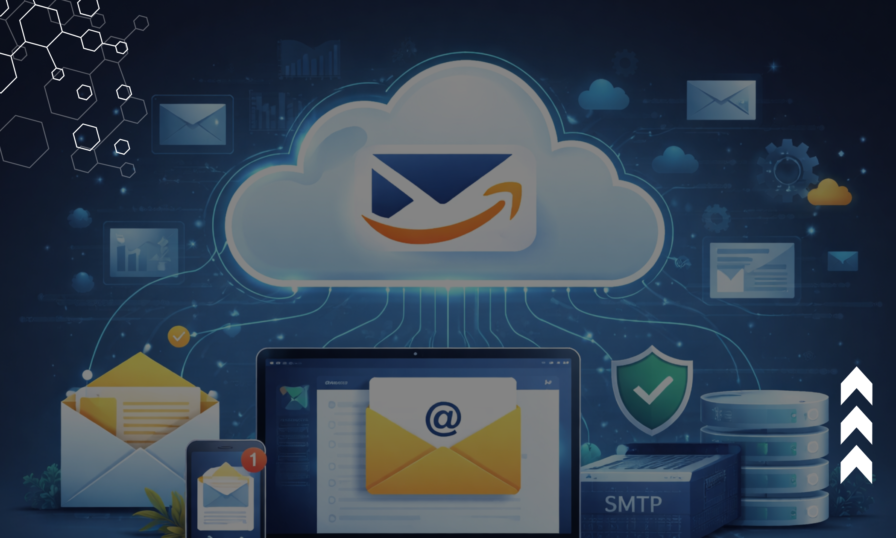
Amazon SES: Email sending on AWS
Email remains one of the most strategic channels for companies wishing to communicate with their users directly, efficiently, and scalably. Whether for sending notifications, registration confirmations, or relationship campaigns, the reliable delivery of these messages is essential for customer experience and business results.
However, managing email delivery on a large scale is not a simple task. Problems such as low deliverability, high costs, spam blocks, and technical limitations can compromise the entire operation, especially in fast-growing systems.
It is in this context that cloud-based solutions take center stage. Among them, Amazon SES (Simple Email Service), from Amazon Web Services (AWS), stands out as one of the most robust and affordable options on the market for high-volume email delivery.
This type of technology often operates behind the scenes, but it is essential for business operations. Learn more about digital infrastructure in this content.
In this article, you will understand what Amazon SES is, how it works, its main benefits, use cases, and when it is worth adopting into your architecture.
What is Amazon SES?
Amazon SES (Simple Email Service) is a cloud-based email sending service designed to allow businesses and developers to send messages in a scalable, secure manner with a high delivery rate.
Unlike traditional email marketing services, SES is primarily focused on transactional and automated emails, such as:
- Registration confirmations
- Password recovery
- System notifications
- Alerts and updates
As part of the AWS ecosystem, it offers native integration with other services, such as Lambda, S3, and CloudWatch.
How does Amazon SES work?
Sending via SMTP
SES can be used as a traditional SMTP server, facilitating integration with existing applications such as legacy systems, CMSs, and ERPs.
Sending via API
For modern applications, using the SES API is the most flexible approach. With it, you can automate sending, personalize messages, and integrate the service into event-driven architectures.
In modern architectures, the use of services like SES is directly linked to best practices in development and operations. See how this applies in practice in this article on DevOps governance.
Reputation Management
Amazon SES offers detailed metrics on bounce rates, spam complaints, and successful deliveries, as well as mechanisms to protect domain reputation.
Main Benefits of Amazon SES
- Low cost: Highly competitive model compared to other solutions.
- High scalability: Ability to send in large volumes.
- High deliverability: Reliable infrastructure.
- Security: Support for SPF, DKIM, and DMARC.
- Integration: Connection with AWS services.
Amazon SES Use Cases
Transactional Emails
- Purchase confirmations
- Password recovery
- Account verification
Automated Notifications
- System alerts
- Real-time updates
Systems and Applications
- Communication with users
- Automated workflows
The use of SES varies according to the type of application. If you are structuring a system, it is worth understanding the differences better in this article about types of applications and interfaces.
Amazon SES vs. Other Email Services
| Critério | Amazon SES | SendGrid | Mailgun |
|---|---|---|---|
| Cost | Very low | Medium | Medium |
| Scalability | High | High | High |
| Ease of use | Medium | High | Medium |
| Flexibility | High | Medium | High |
How to Get Started with Amazon SES
- Create an AWS account
- Access the Amazon SES service
- Verify domain or email
- Exit sandbox mode
- Configure sending via SMTP or API
Best Practices for Using Amazon SES
- Perform domain warming
- Avoid sending to unauthorized lists
- Configure SPF, DKIM, and DMARC
- Monitor sending metrics
- Segment contact lists
Additionally, ensuring the security of integrations is essential to maintain email delivery reliability. Learn more about API security in this content.
When is it Worth Using Amazon SES?
- Companies with a high volume of email sending
- Growing startups
- Systems with critical communication needs
- Teams with technical maturity
Conclusion
Amazon SES establishes itself as an efficient solution for large-scale email sending. Combining low cost, high scalability, and integration with the AWS ecosystem, it serves companies that require performance and reliability.
Although it demands technical knowledge, the gain in efficiency and control makes its adoption a strategic decision for growing systems.
Implementation
If your company seeks to evolve email communication and ensure consistent deliveries, implementing Amazon SES can be an important step within your architecture.