
When a company decides to create an app or system, the focus is usually on the initial investment: design, development, testing, and launch. But there is a point that often goes unnoticed — the cost of maintaining apps after launch.
Unlike a physical product, software is never truly finished when it’s done. It needs to be maintained, updated, secured, and constantly adapted. In practice, industry experts typically estimate that maintaining software can cost between 15% and 20% of the initial investment per year, depending on the complexity of the application, the number of users, and the number of integrations involved. This cost isn’t just technical — it covers infrastructure, security, user support, and product evolution. This is what we call TCO (Total Cost of Ownership).
What is TCO (Total Cost of Ownership)
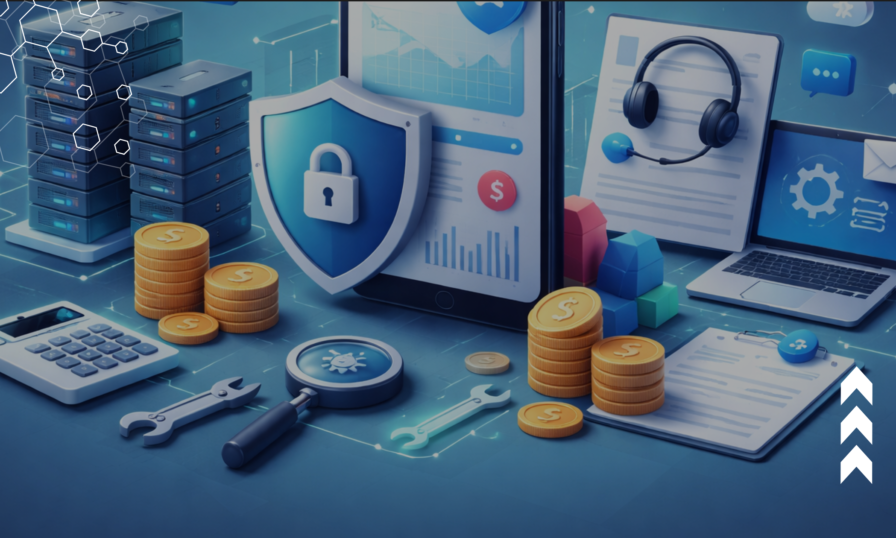
The TCO represents the complete cost of a system over time — not just the amount paid to develop the application, but everything required to keep it running with security, performance, and relevance. In the case of apps and digital systems, this cost encompasses infrastructure and servers, hosting, application security, technical updates, user support, and the functional evolution of the system as a whole.
Ignoring these factors can lead to misguided decisions, such as underestimating the investment required to sustain software in the long term.
The main invisible costs of an app
Once an app goes live, a series of expenses becomes part of the project’s routine. Many of these do not appear in the initial planning, but they are indispensable for the system to continue functioning with quality.
Infrastructure and servers
Every app needs infrastructure to function. This includes processing servers, data storage, databases, content delivery networks, and monitoring services. Apps need to work 24 hours a day, 7 days a week, which requires redundancy and the capacity to scale as the number of users grows. The adoption de of cloud infrastructure is increasingly common precisely because of the flexibility it offers for this growth — but even so, as the system evolves, infrastructure costs follow this expansion.
Application Security
Security is one of the most important pillars of system maintenance. Applications must be continuously updated to address vulnerabilities discovered in libraries, new operating system versions, changes in encryption standards, and browser updates. In addition, many companies need to maintain digital certificates, firewalls, and protection systems against cyberattacks. This set of measures is part of preventive maintenance, Its purpose is to prevent failures and data breaches — And a critical part of this work involves ensuring the security of the APIs and integrations that connect the system to other services.
System updates and adaptations
The digital environment is constantly changing. New laws, market regulations, changes in internal processes, and technological advancements require continuous adaptations to software. This type of intervention is known as adaptive maintenance — and includes everything from compliance with new regulatory requirements to integration with new systems and upgrades to newer platform versions. Even when an application is functioning properly, these changes are inevitable.
Technical support and user assistance
Another important factor in application maintenance costs is support. Depending on the business model, users may need assistance to resolve questions, understand features, fix issues, and recover account access. Companies can choose different strategies: a human support team, a comprehensive knowledge base, technical documentation, or highly intuitive interfaces. Regardless of the approach, investment is required to ensure that users can use the system without friction.
The relationship between software growth and increasing costs
There is an important point that many companies only discover after launch: the larger the software, the higher the maintenance costs. Larger systems require more processing power, more storage, greater security, more monitoring, and more testing. As the product evolves and new features are added, complexity increases—and with it, the level of ongoing investment required to keep everything running smoothly.
Why it’s important to plan for maintenance costs from the start
When planning an application, many companies only consider the development cost. However, the success of a software product depends on its ability to evolve over time. If maintenance investment is not taken into account, the system can quickly become outdated, insecure, incompatible with new technologies, and less competitive in the market. In other words, the software may lose value even if it was expensive to develop.
How to estimate application maintenance costs
A practical way to plan for maintenance costs is to start with a few key factors. A common market practice is to allocate between 15% and 20% of the development cost per year to cover maintenance expenses. From there, other factors come into play, such as the complexity of the application—the greater the number of features, integrations, and users, the higher the maintenance cost tends to be—as well as the system’s criticality and business model. Applications that handle sensitive data or support critical operations require more security, testing, and monitoring than simple internal-use products.
Software is a living asset
Unlike a traditional product, an application does not remain static. It needs to evolve alongside the market, technology, business processes, and user expectations. That is why understanding application maintenance costs is essential for making strategic and sustainable decisions.
Companies that plan for this investment from the beginning are able to keep their systems secure, up to date, and competitive for much longer. If you are considering developing an application or software system, take into account not only the development cost, but also the ongoing investment required to maintain it over time, but the entire lifecycle of the solution. This broader perspective helps avoid unexpected costs and turns software into a truly sustainable asset for the business.
Frequently asked questions about application maintenance costs
How much does it cost to maintain an application per year?
The market generally estimates annual maintenance costs at between 15% and 20% of the original development cost, depending on the application’s complexity, number of users, and required integrations.
What is TCO in software?
TCO (Total Cost of Ownership) is the total cost of owning a software system. It includes not only the development cost, but also all the infrastructure, security, support, and ongoing updates required throughout the system’s lifecycle.
What are the main hidden costs of an application?
The main hidden costs are infrastructure and servers, application security, system updates and adaptations, and technical support for users.
What is adaptive software maintenance?
It is the type of maintenance performed to adapt a system to external changes, such as new regulations, platform updates, or integrations with other systems.